
Leadership X — Roundtable 1 Report
AI literacy, decision intelligence and responsible AI governance for senior executives — a cross-sector synthesis of the first Leadership X Academy roundtable, with Egypt’s AI market and governance landscape to March 2026.
Download the full PDFOpen in the interactive readerاقرأ بالعربية
Executive summary
The first Leadership X Academy Roundtable convened senior leaders from a deliberately diverse mix of public institutions, private industry, academia and research. Its premise: AI readiness is no longer a technical agenda delegated to IT teams — it is an executive governance capability that requires shared language, informed decision-making, accountable leadership and cross-sector collaboration.
- Literacy linked to governance. Senior leaders need enough fluency to understand what AI systems can and cannot do, where risk enters the lifecycle, what to ask of vendors and internal teams, and when human accountability must remain decisive.
- Decision Intelligence as the bridge. Data describes what is happening; decision frameworks structure what should be done; AI can augment prediction, prioritization and execution — but should not displace executive accountability.
- Cross-sector learning. Banking, retail, hospitality, pharmaceuticals, industry, business associations, government, diplomacy, academia and research face different use cases, yet share common governance needs: data quality, privacy, risk classification, human oversight, transparency, cybersecurity, workforce readiness and continuous monitoring.
- Egypt’s momentum. The National AI Strategy 2025–2030 targets 30,000 AI professionals, 250+ AI companies and 6,000 AI-related publications a year by 2030; the ICT sector reached about 6% of GDP in 2025 and digital exports USD 7.4 billion 15.
AI literacy without governance can accelerate unmanaged risk; governance without literacy can become procedural and detached from business reality.
Event profile
- Roundtable: Leadership X Academy — AI for Senior Executives
- Date: 14 February 2026
- Location: Triumph Luxury Hotel, New Cairo, Egypt
- Host: ACG – Abdin’s Consultancy Group
- Moderator: Marwan Abdin, Founder & CEO, ACG
- Format: three-hour executive roundtable and moderated cross-sector discussion
Leadership X was designed to move beyond general AI awareness toward practical leadership readiness — connecting AI literacy, business and decision intelligence, AI maturity, responsible adoption, digital transformation and governance, through dialogue across sectors rather than a one-directional technology lecture. The timing mattered: with the second edition of the National AI Strategy launched in 2025, national attention was shifting from strategy to implementation, institutional readiness and sector adoption 16.

A cross-sector table
Seventeen senior participants and representatives took part. In line with the report’s confidentiality approach, individual and organization names are not reproduced. The cohort spanned:
- Banking and financial services
- Retail, apparel and consumer goods
- Hospitality and tourism
- Pharmaceuticals and healthcare
- Industry and manufacturing policy
- Business associations and development cooperation
- Government, public policy and diplomacy
- Academia and research
- Digital transformation and institutional operations
AI governance is inherently cross-functional. The same model may affect customers, employees, citizens, regulators, researchers, suppliers and international partners at once — a multi-sector table surfaces dependencies that stay invisible inside single-industry discussions: interoperability, data-sharing boundaries, procurement standards, skills mobility, research commercialization and public trust.
From AI literacy to AI governance
At senior level, AI literacy is not prompt-writing or tool familiarity. It is the capacity to lead, question, authorize, challenge and govern AI-enabled decisions.
- Conceptual literacy: AI, machine learning, generative AI, predictive models, automation — and the limits of probabilistic systems.
- Data literacy: provenance, quality, representativeness, privacy and access rights.
- Decision literacy: which decisions AI can augment, which need structured human judgment, and where escalation or override is mandatory.
- Risk literacy: bias, hallucination, opacity, cybersecurity, drift, IP, vendor dependence and concentration risk.
- Governance literacy: accountability, impact assessment, approval gates, documentation, monitoring, audit, procurement and incident response.
- Change literacy: AI changes roles, workflows, incentives and power structures — deployment needs workforce engagement.

AI governance should be owned at the level where business accountability sits. Technology teams design controls and operate systems; executive leadership determines purpose, risk appetite, trade-offs, escalation thresholds and accountability.
Governance as an operating capability
Responsible AI is not achieved by publishing a policy. It becomes real when embedded in decision rights, procedures and management routines:
- An accountable executive sponsor and clearly assigned AI ownership
- An inventory of AI use cases, models, tools and vendors
- Risk-based classification before deployment
- Proportionate data and privacy checks
- Human oversight for consequential decisions
- Approval gates for procurement, pilots and production
- Documentation of assumptions, limitations and intended users
- Monitoring for performance, drift and incidents
- Role- and risk-appropriate workforce training
- Periodic executive review of benefits, risks and business justification
Decision Intelligence as an executive capability
A recurring Leadership X theme is the progression from Business Intelligence to Decision Intelligence to AI Integration — because many organizations invest in dashboards and AI tools without redesigning the decision itself.
- Business Intelligence — what is happening? Visibility, trends, KPIs and exceptions; AI automates data preparation and summarizes insight.
- Decision Intelligence — what should we do, and why? Options, trade-offs, scenarios and decision criteria; AI supports prediction, optimization and simulation.
- AI Integration — how can the process be augmented responsibly? Faster execution with defined controls; agents, copilots and workflow automation with continuous monitoring.
The highest-value opportunity is rarely “use AI somewhere” — it is “improve a specific recurring decision”. That means defining the decision owner, data inputs, frequency, performance measure, acceptable error, human override and learning loop before choosing a model or platform.
Voices from the table
Select any photo to view it full-screen.
 Exchanging perspectives on AI literacy for senior leaders
 Listening to the case for decision intelligence
 Linking AI maturity to organizational readiness
 Reflecting on governance as an operating capability
 Raising questions on data, privacy and human oversight
 Sharing sector experience across the table
Egypt’s AI market and governance (to 31 March 2026)
National direction. The National AI Strategy, Second Edition (2025–2030), rests on six pillars — Governance, Technology, Data, Infrastructure, Ecosystem and Talent — and targets a 7.7% ICT contribution to GDP by 2030, 30,000 AI professionals, 250+ successful AI companies and 6,000 AI-related publications a year 1.
A strong digital base. ICT growth ran at 14–16% with around 6% of GDP; digital exports reached about USD 7.4 billion in 2025 and offshoring exports USD 4.8 billion, up from USD 2.4 billion in 2022 59.
Readiness: strong policy, uneven execution. In the 2025 Government AI Readiness Index, Egypt ranked 51st of 195 countries — first in Africa, third in the Arab region — with a perfect 100 in Policy Capacity, but 46.06 in AI Infrastructure and 45.41 in Development & Diffusion 6. UNESCO’s 2025 assessment pointed to computing infrastructure, capacity building, regulatory clarity, data governance and cross-sector partnership as priorities 34.
A more operational governance architecture.
- The Egyptian Charter for Responsible AI (2023) — a non-binding ethical reference point 2.
- The Personal Data Protection Law No. 151 of 2020 and its Executive Regulations No. 816 of 2025 10.
- The Guide to Egypt’s National AI Governance Framework, authorized 15 March 2026, with a four-tier risk model — prohibited, high, limited and minimal risk — and calls for a Chief AI Officer or equivalent in government and high-risk enterprises 7.
- The National Guidelines for Trustworthy and Responsible AI, finalized in March 2026, translating policy into organizational controls and measurable leadership accountability 8.
The March 2026 framework and guidelines were released after the 14 February roundtable. They validate its executive-governance focus; the report does not claim their provisions were discussed at the session.
Cross-sector implications
- Banking and financial services: credit decision support, fraud/AML analytics and client intelligence — governed through explainability, model risk, human override, auditability and vendor oversight.
- Retail and consumer goods: forecasting, personalization and pricing — with attention to consent, discriminatory profiling, pricing fairness and hallucinated product claims.
- Hospitality and tourism: revenue management, multilingual assistants and sentiment analysis — governing guest data, cross-border processing and workforce impact.
- Pharmaceuticals and healthcare: literature intelligence, pharmacovigilance and supply forecasting — requiring rigorous validation, data lineage and clear boundaries with clinical authority.
- Industry and manufacturing: predictive maintenance, quality inspection and energy efficiency — with cyber-physical safety, reliability and incident response in view.
- Government and diplomacy: service delivery, policy analysis and foresight — held to a higher trust threshold of due process, transparency and public accountability.
- Business associations: accelerating diffusion of AI literacy and responsible practice across SMEs through shared training, templates and policy feedback.
- Academia and research: faster literature review and modeling — with research integrity, disclosure of AI use, reproducibility and stronger industry–academia pathways.

ACG’s contribution
ACG contributed at three levels — convening, moderation and framework translation — positioning AI around executive capability and organizational transformation rather than as a standalone technology topic.
- Cross-sector convening: a curated forum where public, private, academic and research perspectives meet.
- Executive moderation: Marwan Abdin steered the session around leadership questions — which decisions matter, where AI creates value, which risks need oversight, and how leaders empower teams without losing accountability.
- AI literacy and maturity: executive fluency connected to strategy, people, process, data, technology, governance and change readiness.
- From BI to Decision Intelligence: concrete use cases linked to real responsibilities, not abstract experimentation.
- Responsible AI and governance: governance elevated from a compliance afterthought to a design requirement.
- Team empowerment: clear objectives, guardrails, skills and permission to experiment within governed boundaries.
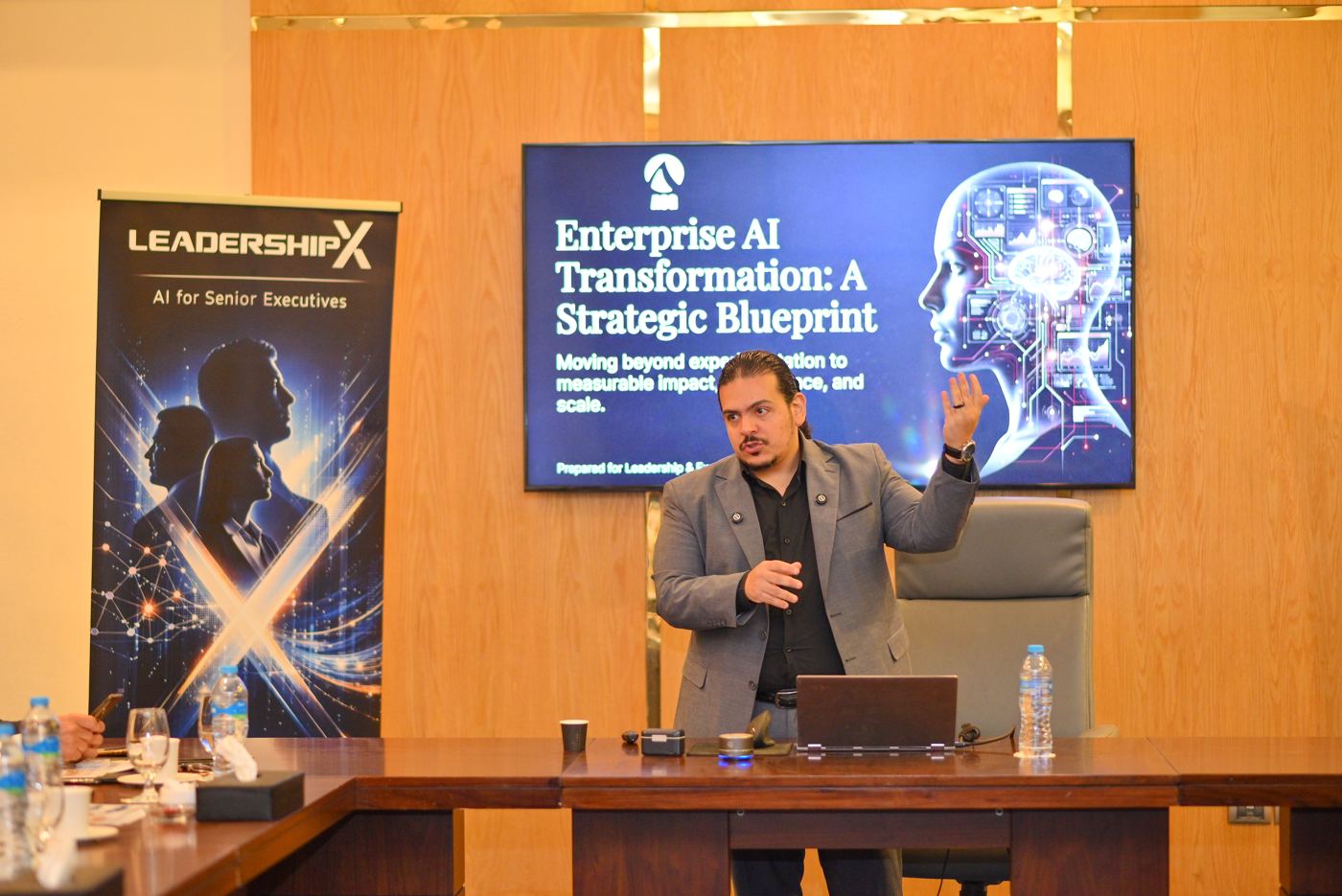
Leaders do not need to become data scientists — but they do need enough AI fluency to govern strategy, decisions, risk, people and accountability.
Recommendations
- Make executive AI literacy a governance requirement — role-specific, covering capabilities, limits, decision risk, data, privacy, cyber risk, oversight and procurement.
- Name executive accountability for AI — a senior owner backed by a cross-functional committee.
- Create an enterprise AI register — shadow AI cannot be governed if it is not visible.
- Classify use cases by risk — stronger assessment, validation and oversight for high-impact systems.
- Govern decisions, not only models — define what AI may recommend, automate or merely inform.
- Integrate AI governance with data governance and PDPL compliance.
- Strengthen procurement and vendor governance — disclosure, testing evidence, incident procedures and exit arrangements.
- Build controlled experimentation pathways — sandboxes and pilots with success metrics and stop conditions.
- Monitor continuously — performance, drift, bias, security events, complaints and override rates.
- Use public–private–academic collaboration as infrastructure — recurring forums, applied research and sector working groups.
- Invest in middle management — where governance becomes operational.
- Measure maturity and value together — balanced KPIs, not tool counts.
Voices from the table, continued
 Weighing the risks and opportunities of AI adoption
 Contributing to the cross-sector discussion
 Discussing practical controls for responsible AI
 Following the executive dialogue
 Making the case for team empowerment within guardrails
An executive AI governance operating model
- Purpose & strategy: a use-case portfolio linked to strategic priorities and accountable sponsors.
- Leadership & accountability: a senior AI owner and a cross-functional governance committee.
- Data & privacy: data owners, PDPL review, access controls and data-quality checks.
- Risk & human oversight: risk tiers, impact assessment, human override and stop conditions.
- Technical assurance: testing, validation, security and robustness evidence.
- Deployment & change: role-based training, SOPs, workflow redesign and adoption support.
- Monitoring & learning: KPIs, incident reporting, drift monitoring, audits and executive review.
A 12-month roadmap
- 0–90 days: executive literacy, an accountable sponsor, an AI inventory, a governance committee and interim principles.
- 3–6 months: risk classification, data and privacy controls, procurement rules, and 2–4 priority use cases in controlled pilots.
- 6–9 months: scale successful pilots, establish monitoring, role-based training, vendor assurance and incident procedures.
- 9–12 months: independent review, portfolio optimization, retire low-value tools and strengthen research and industry partnerships.
Conclusion
The common denominator across the table was not a specific technology — it was leadership responsibility. Egypt’s AI trajectory shows clear strategic momentum, yet the gap between national ambition and enterprise execution remains the central challenge 13578. Leadership X addresses the layer that connects the two: senior executive fluency, decision intelligence, governance, cross-sector dialogue and organizational maturity. The next stage deepens the model through sector-specific roundtables, maturity assessments, applied use-case design and ongoing public–private–academic collaboration.
Responsible AI implementation is not achieved by slowing innovation. It is achieved by giving leaders the knowledge, decision structures and governance mechanisms to innovate with clarity, accountability and trust.
References
- National Council for AI — Egypt National AI Strategy, Second Edition (2025–2030)
- National Council for AI — Egyptian Charter for Responsible AI (2023)
- UNESCO — Egypt charts a path towards ethical and inclusive AI (16 Oct 2025)
- UNESCO — Egypt: Artificial Intelligence Readiness Assessment Report (2025)
- State Information Service — Digital Egypt ICT achievements (23 Dec 2025)
- National Bank of Egypt — Economic Bulletin, 1st Issue 2026 (Government AI Readiness Index 2025)
- Guide to Egypt’s National AI Governance Framework, Edition 2.0 (15 Mar 2026)
- Egypt National Guidelines for Trustworthy and Responsible AI, Edition 2.0 (Mar 2026)
- ITIDA — Egypt doubles digital offshoring exports to USD 4.8B (11 Nov 2025)
- Personal Data Protection Center — PDPL No. 151 of 2020 and Executive Regulations No. 816 of 2025