
The EU Market Access Blueprint for MENA AI Startups
How the EU AI Act reaches founders in the MENA region — the risk tiers, your legal role, the compliance loop and deadlines — with a three-phase action plan for entering the EU market.
Download the full PDFOpen in the interactive readerاقرأ بالعربية

Why the EU AI Act reaches MENA founders
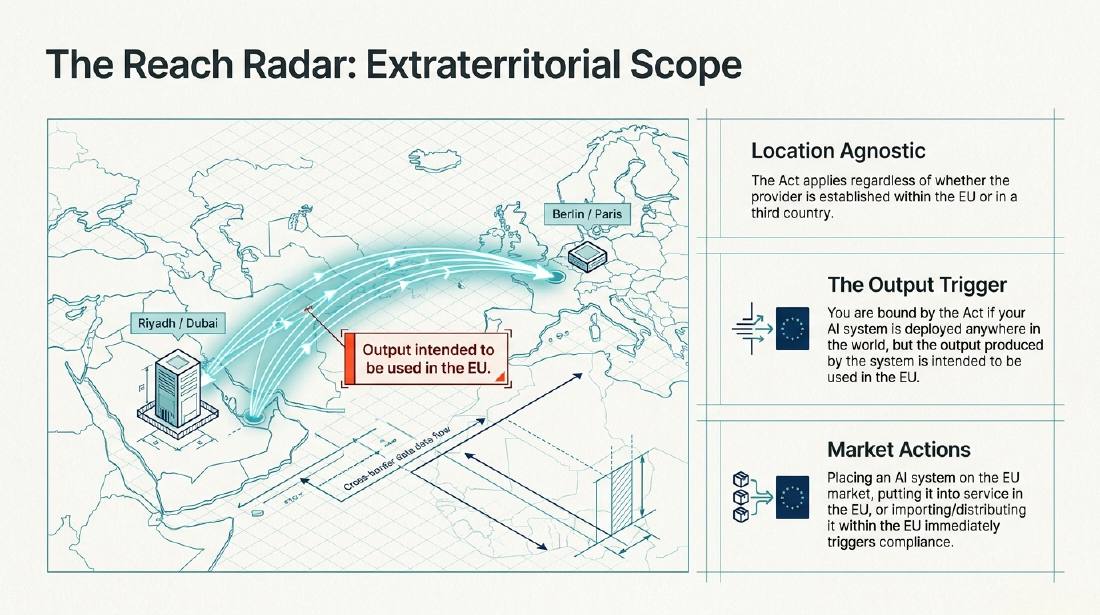
The EU AI Act is location-agnostic. It applies whether a provider is established in the EU or in a third country — so a startup in Riyadh, Dubai or Cairo is bound by it as soon as the output of its AI system is intended to be used in the EU 12.
- The output trigger: your system can run anywhere in the world; if what it produces is used in the EU, the Act applies.
- Market actions: placing an AI system on the EU market, putting it into service there, or importing or distributing it immediately triggers compliance.
The risk pyramid
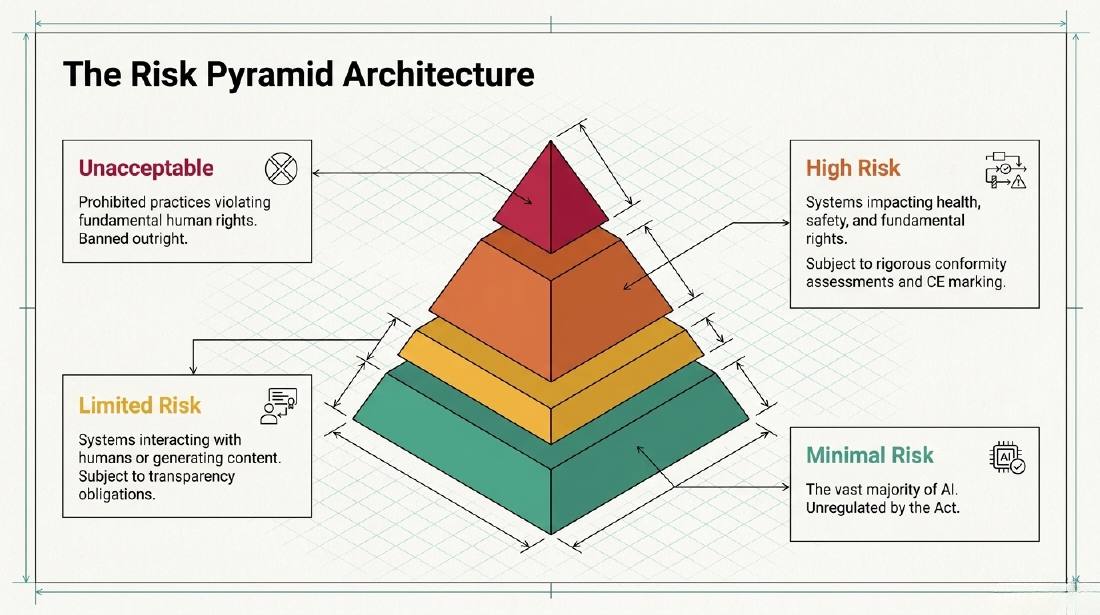
The Act sorts AI by the risk it poses, and the obligations follow the tier 3:
- Unacceptable risk: practices that violate fundamental rights — banned outright.
- High risk: systems affecting health, safety and fundamental rights — subject to rigorous conformity assessments and CE marking.
- Limited risk: systems that interact with people or generate content — transparency obligations.
- Minimal risk: the vast majority of AI — not regulated by the Act.
Models versus systems
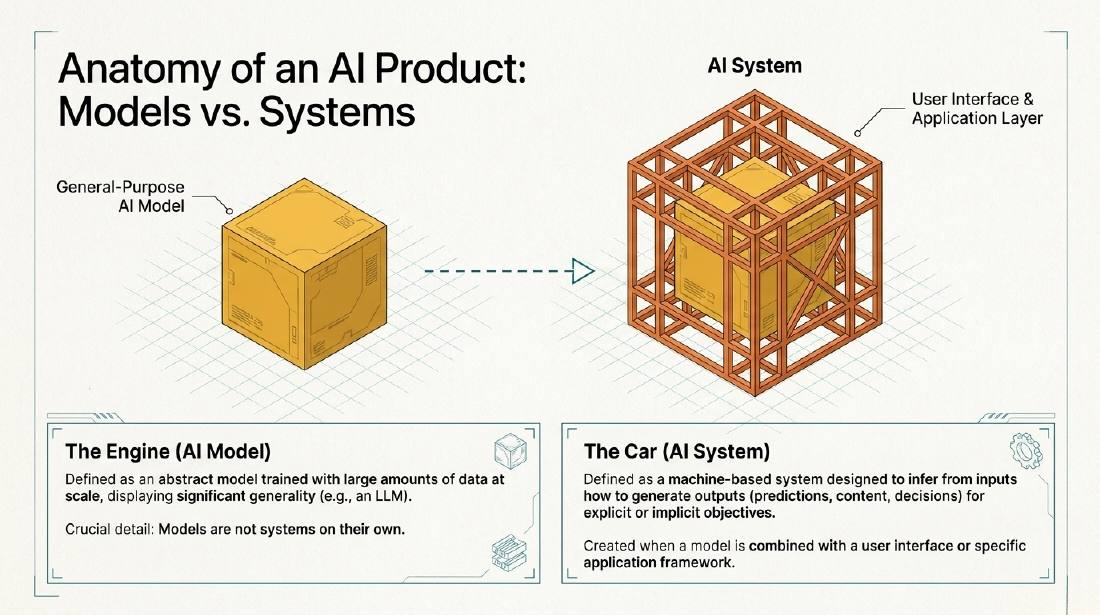
A general-purpose AI model is the engine: trained on large amounts of data and showing significant generality, such as a large language model. Models are not systems on their own. An AI system is the car: a machine-based system that infers from inputs how to generate outputs — predictions, content or decisions. It is created when a model is combined with a user interface or an application framework.
The prohibited zone
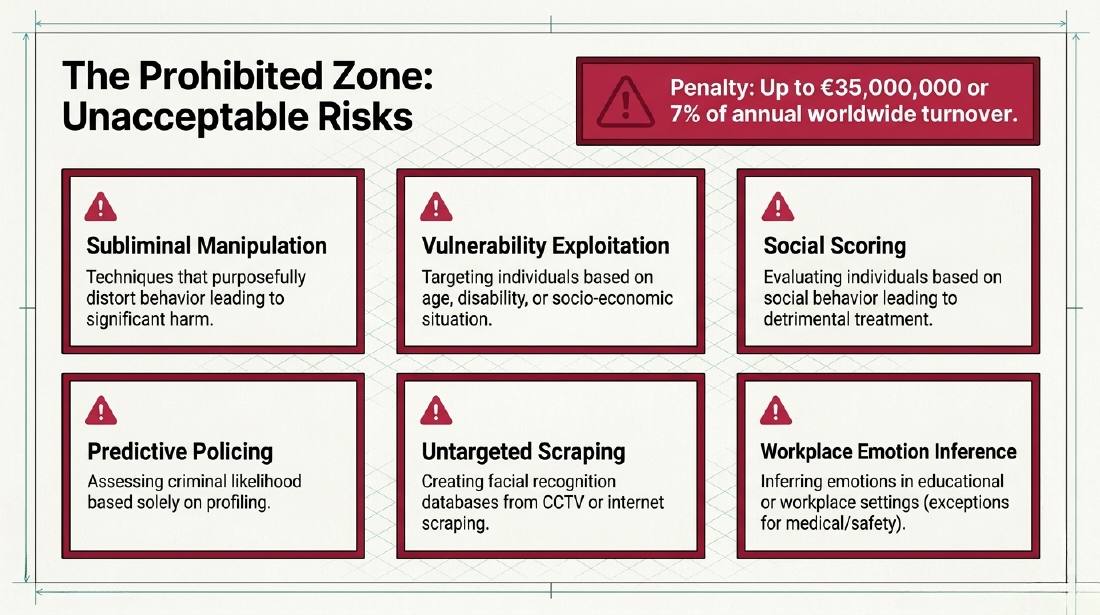
Six practices are off-limits: subliminal manipulation, exploiting vulnerabilities linked to age, disability or socio-economic situation, social scoring, predictive policing based solely on profiling, untargeted scraping to build facial-recognition databases, and inferring emotions in workplaces or education (with medical and safety exceptions).
Penalties for prohibited practices reach €35 million or 7% of annual worldwide turnover.
Is your system high-risk?
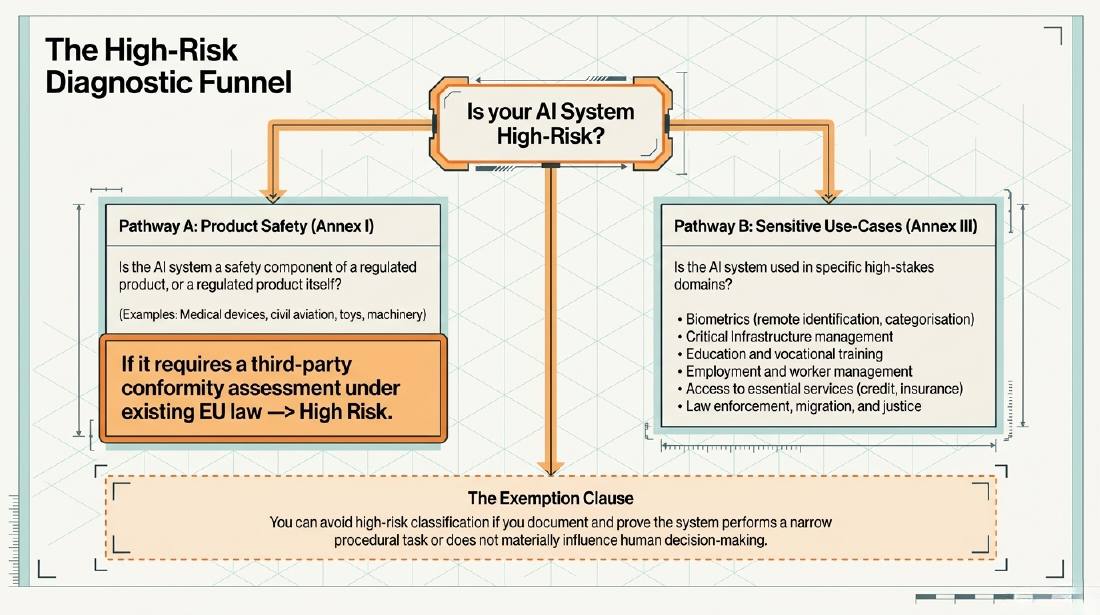
There are two pathways. Pathway A (Annex I) covers AI that is a safety component of a regulated product — medical devices, civil aviation, toys, machinery — where existing EU law requires a third-party conformity assessment. Pathway B (Annex III) covers sensitive use cases: biometrics, critical infrastructure, education and vocational training, employment and worker management, access to essential services such as credit and insurance, and law enforcement, migration and justice.
The exemption clause lets you avoid the high-risk label if you document and prove that the system performs a narrow procedural task or does not materially influence human decision-making.
Know your role in the supply chain
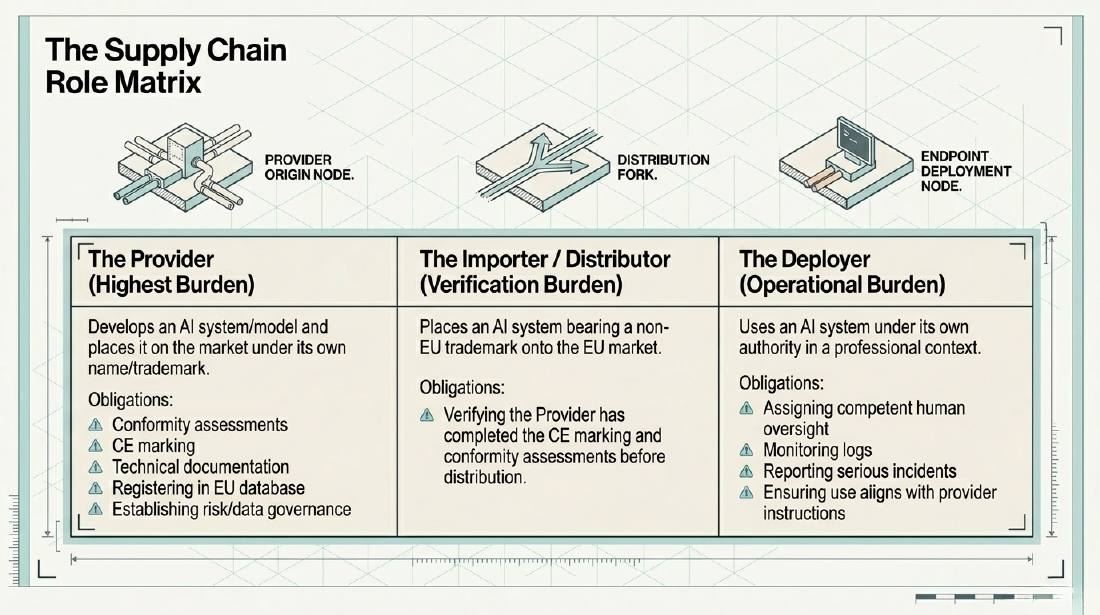
- Provider — the highest burden: conformity assessments, CE marking, technical documentation, registration in the EU database, and risk and data governance.
- Importer or distributor — verification: confirm the provider completed CE marking and conformity assessment before distribution.
- Deployer — operational: competent human oversight, monitoring logs, reporting serious incidents, and using the system as the provider instructs.
The provider metamorphosis
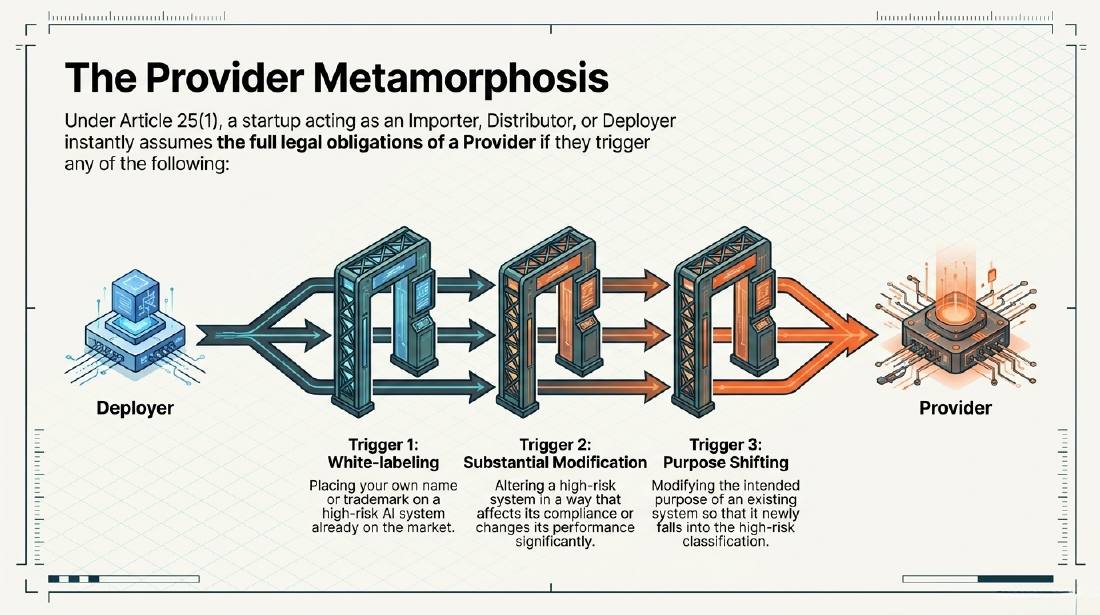
Under Article 25(1), an importer, distributor or deployer takes on the full legal obligations of a provider if it puts its own name or trademark on a high-risk system (white-labelling), substantially modifies it, or changes its intended purpose so that it becomes high-risk.
The high-risk compliance loop
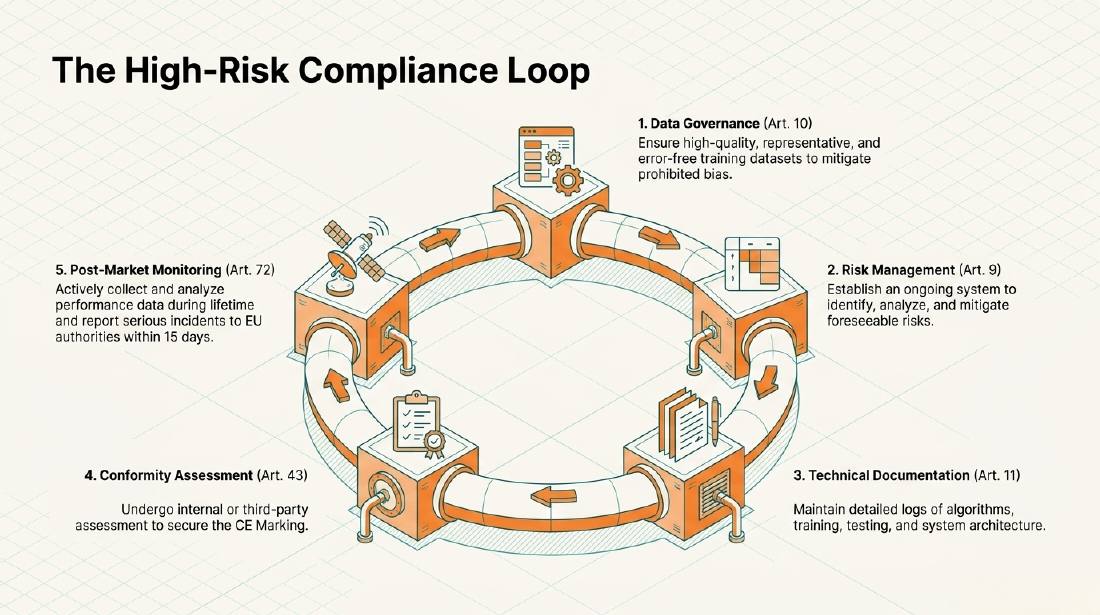
- Data governance (Art. 10): high-quality, representative, error-free training data to mitigate bias.
- Risk management (Art. 9): an ongoing system to identify, analyse and mitigate foreseeable risks.
- Technical documentation (Art. 11): detailed records of algorithms, training, testing and architecture.
- Conformity assessment (Art. 43): internal or third-party assessment to secure the CE marking.
- Post-market monitoring (Art. 72): collect performance data for the system’s lifetime and report serious incidents within 15 days.
General-purpose AI: two tiers
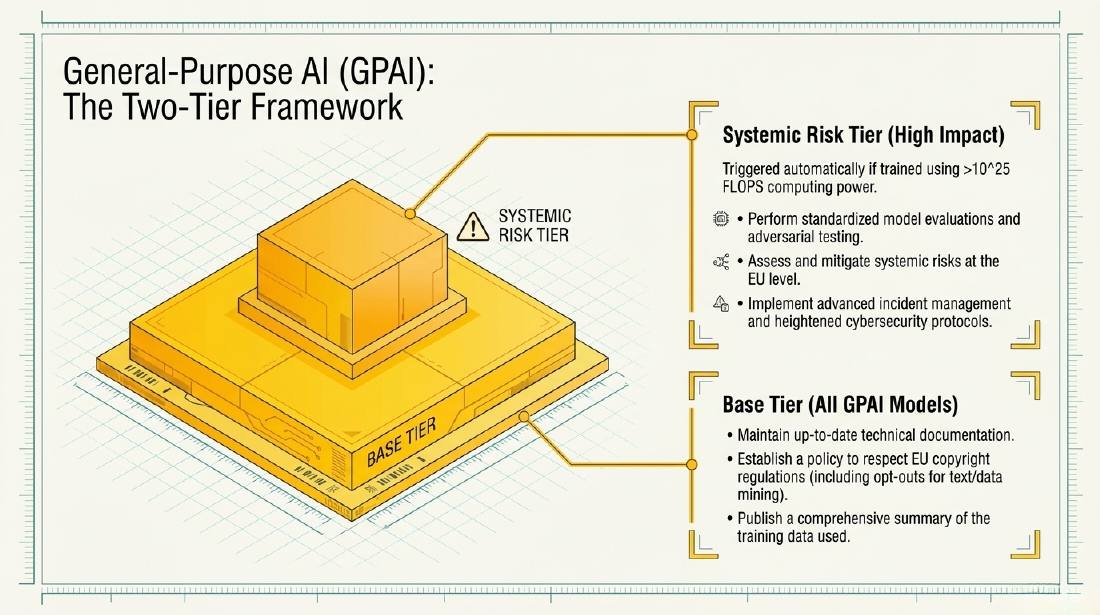
Every GPAI model must keep technical documentation up to date, respect EU copyright rules (including text-and-data-mining opt-outs) and publish a summary of its training data. Models trained with more than 10^25 FLOPs fall into the systemic-risk tier, which adds standardised evaluations and adversarial testing, EU-level risk mitigation, incident management and stronger cybersecurity.
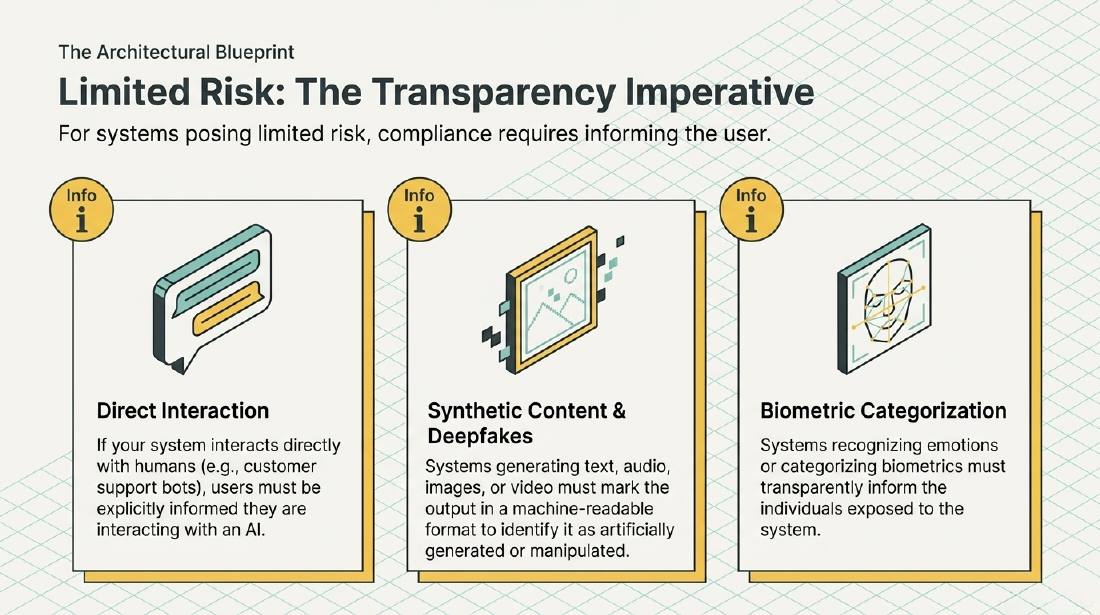
Limited risk: the transparency imperative
People must be told when they are talking to an AI; synthetic text, audio, images and video must be marked in a machine-readable way; and people exposed to emotion recognition or biometric categorisation must be informed.
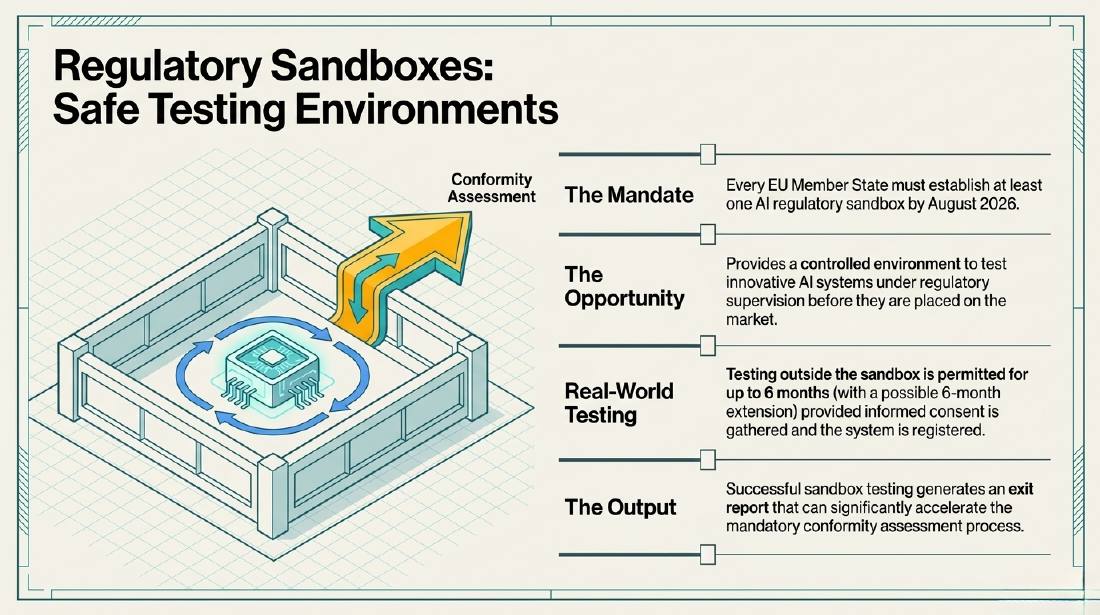
Regulatory sandboxes
Every EU Member State must set up at least one AI regulatory sandbox by August 2026 — a supervised environment to test innovative systems before they reach the market 4. Real-world testing outside the sandbox is allowed for up to six months (extendable by six) with informed consent and registration, and a successful sandbox exit report can speed up the conformity assessment.
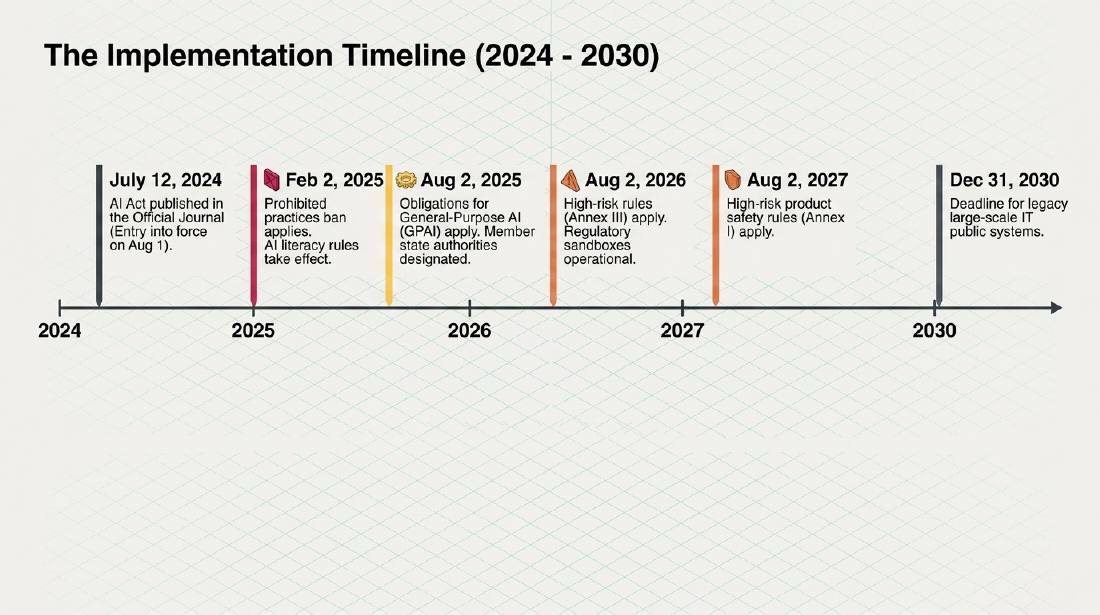
The implementation timeline
- 12 July 2024: published in the Official Journal (in force from 1 August 2024).
- 2 February 2025: the ban on prohibited practices and the AI literacy rules apply.
- 2 August 2025: general-purpose AI obligations apply; national authorities designated.
- 2 August 2026: high-risk rules (Annex III) apply; sandboxes operational.
- 2 August 2027: high-risk product-safety rules (Annex I) apply.
- 31 December 2030: deadline for legacy large-scale public IT systems.
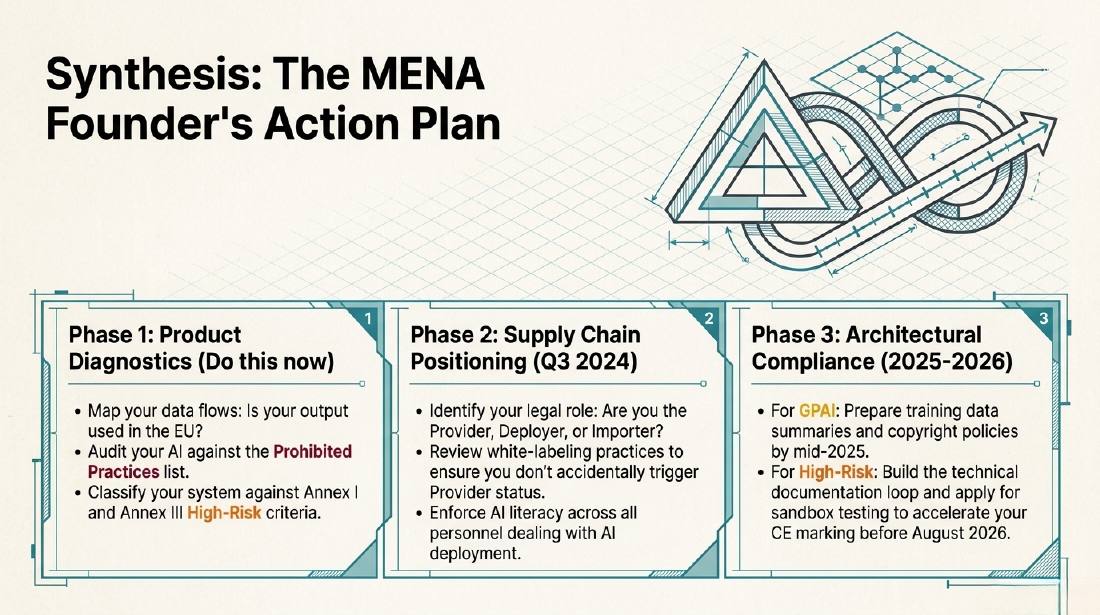
The MENA founder’s action plan
- Product diagnostics — now: map your data flows (is your output used in the EU?), audit against the prohibited-practices list, and classify your system against Annex I and Annex III.
- Supply-chain positioning: identify your legal role — provider, deployer or importer — review white-labelling so you do not trigger provider status by accident, and enforce AI literacy for everyone deploying AI.
- Architectural compliance: for GPAI, prepare training-data summaries and copyright policies; for high-risk systems, build the technical documentation loop and use sandbox testing to accelerate CE marking.
Download the full illustrated blueprint as a PDF below.
References
- European Parliament (2025). EU AI Act: first regulation on artificial intelligence
- European Commission (2024). AI Act: Shaping Europe’s digital future
- EU Artificial Intelligence Act — Future of Life Institute
- European Commission (2024). Regulatory sandboxes for AI under the EU AI Act
- European Commission High-Level Expert Group on AI (2019). Ethics Guidelines for Trustworthy AI